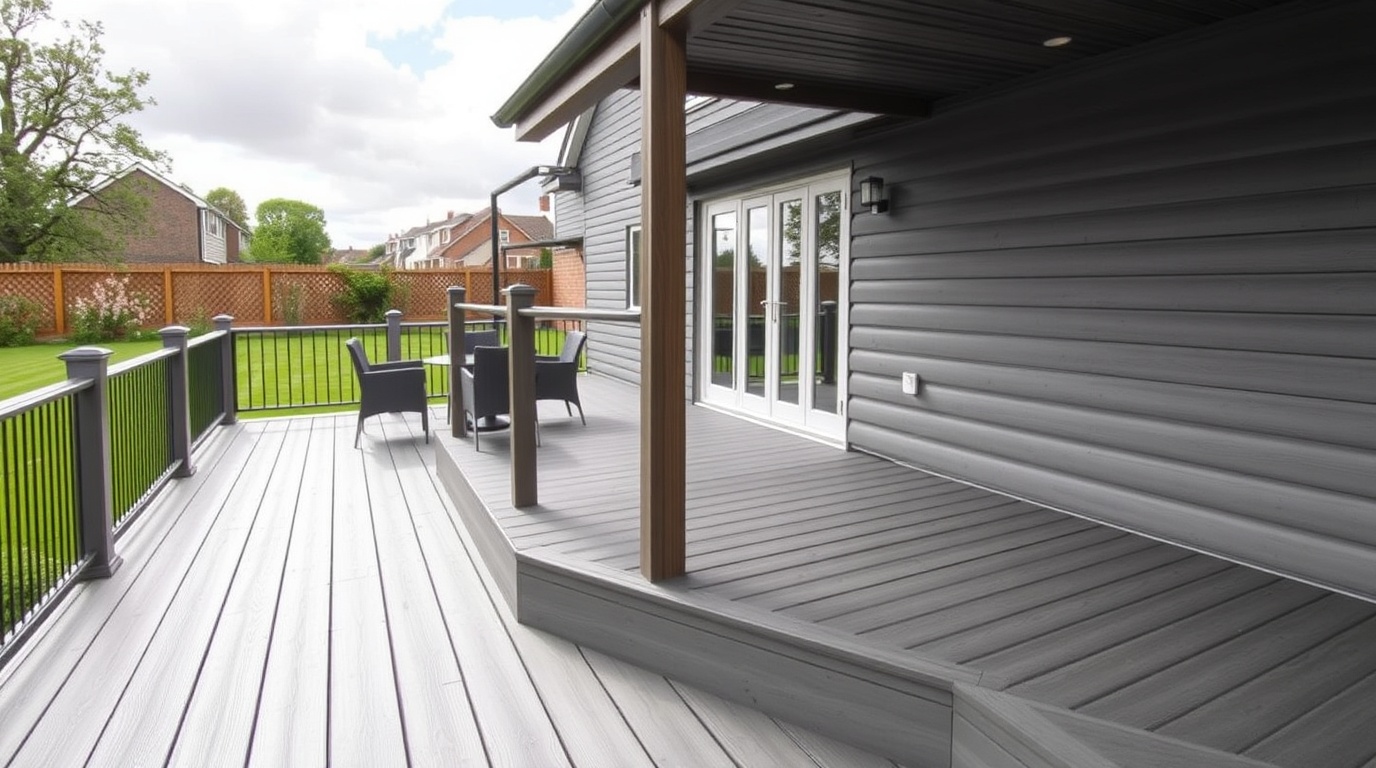
The short answer
The main pros of composite decking are low maintenance (no sanding, staining or sealing — just an occasional wash), a long lifespan of typically 20–30 years, strong resistance to rot, insects, splinters and fading, and a uniform, splinter-free surface that suits bare feet and children. The main cons are a higher upfront cost than timber, a surface that can get warm in direct summer sun, a finish that some find less authentic than real wood up close, and the fact that damaged boards usually have to be replaced rather than sanded or repaired. For households that value low upkeep and longevity and can absorb the higher initial price, the pros usually outweigh the cons.
Composite decking is increasingly popular in UK gardens, but it isn't perfect. This page sets out the genuine advantages and the trade-offs so you can judge whether it fits your project.
At a glance
- MaintenanceVery low
- Typical lifespan20–30 years
- SplintersNone
- Upfront costHigher than timber
- Main drawbackHeat in direct sun
The pros of composite decking
- Low maintenance — no annual sanding, oiling, staining or sealing; an occasional wash with soapy water keeps it clean.
- Long lifespan — quality boards typically last 20–30 years, often with a manufacturer warranty.
- Rot- and insect-resistant — the plastic content means it won't rot, and insects don't eat it.
- No splinters — the surface is consistent and safe for bare feet and children.
- Fade-resistant — capped boards hold their colour well through UV exposure after an initial settling.
- Slip options — many ranges are textured or grooved for grip, and dedicated anti-slip boards exist.
- Recycled content — most composite uses recycled wood fibre and plastic.
- Consistent finish — uniform colour and grain with no knots or warping.
The cons of composite decking
- Higher upfront cost — boards cost noticeably more than treated softwood, and sometimes more than hardwood.
- Heat in sun — the surface can get warm in direct summer sun, more so in darker colours.
- Less authentic up close — convincing from a distance, but it reads as a manufactured product near to.
- Limited repairs — a scratched or damaged board can't be sanded back like wood; it's usually swapped out.
- Surface algae in damp shade — like any surface it can green up in shaded, wet spots and need a clean.
- Thermal movement — boards expand and contract with temperature, so correct gaps at installation matter.
- Not infinitely recyclable — the wood-plastic blend is harder to recycle at end of life than pure timber.
Pros and cons summary
The table summarises how composite performs against the things people care about most.
| Factor | Composite decking |
|---|---|
| Upfront cost | Higher (£40–£90+/m² supplied) |
| Maintenance | Very low — occasional wash |
| Lifespan | 20–30 years typical |
| Rot / insects | Resistant |
| Splinters | None |
| Heat in sun | Can get warm, esp. dark colours |
| Repairing damage | Replace board, not sand |
Indicative supplied range for guidance only. Sources: composite decking manufacturer specifications and Checkatrade cost guidance.
Putting the trade-offs in context
Most of composite's cons are manageable and need weighing against the pros rather than treated as deal-breakers. The higher upfront cost is real, but it buys years without the cleaning, oiling and staining that timber demands, so the lifetime gap narrows. The heat issue only bites in strong direct sun — lighter colours and some shade largely solve it, and the UK climate rarely makes a deck unusable. The less authentic look is subjective; modern multi-tonal, grain-embossed boards are far more convincing than early composite, though wood purists will still prefer timber. Limited repairability matters most for accident-prone areas, but boards can be individually swapped, and the surface resists damage in the first place. And thermal movement is a non-issue when the deck is installed with the correct expansion gaps. Knowing where each drawback applies helps you judge whether they affect your particular garden.
How composite performs in UK conditions
Several of composite's pros and cons come into focus in the British climate specifically. The damp, wet winters that punish timber play to composite's strengths: it won't rot, barely absorbs water, and stays dimensionally stable through repeated wet and dry spells, so it doesn't cup, split or splinter the way neglected wood can. Its main weather weakness is surface algae in shaded, slow-drying spots, which is cosmetic and washes off — a genuine but minor con. The heat con, by contrast, rarely bites in the UK: only in prolonged direct summer sun do darker boards get uncomfortably warm, and lighter colours largely solve it. Frost is a non-issue for composite, since it doesn't soak up the water that damages timber on freezing. On balance, the UK's moisture-dominated climate suits composite well, provided the deck is installed with the drainage, ventilation and expansion gaps that let any board perform — which neutralises the thermal-movement con too.
Cost and value in perspective
The higher upfront cost is the con people weigh most, so it's worth putting in context. Composite boards cost noticeably more than treated softwood and sometimes more than hardwood, and the sub-frame and fitting add to that, so the day-one bill is higher. Against that sit the pros that compound over time: no annual oiling or staining (saving both product cost and a weekend each season), fewer replacements thanks to the 20–30 year lifespan, and a surface that keeps its looks with minimal effort. Over a 15–20 year horizon the gap between composite and a maintained timber deck narrows considerably, and for households that value time and predictability the premium often feels worth it. It's not the right call for every budget — if upfront cost is the binding constraint, timber remains the more economical route — but framing composite as a longer-term investment rather than a simple purchase makes the trade clearer.
Who composite suits — and who it doesn't
Composite decking suits people who want a low-maintenance, long-lasting surface and dislike garden chores, households with children or bare feet who value a splinter-free deck, and shaded or damp gardens where timber would struggle, provided you choose a low-absorption capped board with grip. It's less ideal if your budget is tight and you'd rather spend less now and maintain timber, if you strongly prefer the genuine character of natural wood and don't mind upkeep, or if you want a surface you can sand and refinish over the years. Weighed honestly, composite trades a higher initial price and a slightly engineered look for low effort and longevity — a trade many UK homeowners now happily make, but not one that fits every garden or budget.
Frequently asked questions
What is the biggest downside of composite decking?
The most cited drawbacks are the higher upfront cost compared with timber and the fact the surface can get warm in direct summer sun, especially in darker colours. Damaged boards also have to be replaced rather than sanded. For many owners these are outweighed by the low maintenance and long life, but they're worth knowing.
Does composite decking go mouldy?
Composite resists rot and won't grow mould through its core, but like any outdoor surface it can develop surface algae or green film in damp, shaded spots. This wipes off with a wash and isn't structural. Good drainage, ventilation beneath the deck and the occasional clean keep it at bay.
Is composite decking really maintenance-free?
Not entirely — it's very low maintenance rather than maintenance-free. It needs no sanding, oiling, staining or sealing, but it still benefits from an occasional wash to remove dirt, leaves and any surface algae, particularly in shaded gardens. That's a fraction of the upkeep timber decking requires.
Sources & further reading
Figures on this page are typical UK ranges drawn from published sources and depend on your specific garden. They are guidance, not a quotation.