The short answer
A paved patio is usually the better choice on flat, ground-level areas where you want a hard, very long-lasting surface, while composite decking suits sloping gardens, raised areas or spots over uneven ground where building a level frame is easier than excavating and laying a sub-base. Patio paving lasts a very long time and is robust underfoot, but the surface is hard and cold and can collect surface water if drainage is poor. Composite gives a warmer, softer surface that drains through the gaps between boards and copes well with slopes, though quality boards typically last 20–30 years rather than a lifetime. Cost is broadly comparable for a basic build; the right answer usually follows from the levels and slope of your garden.
Decking and paving are the two main ways to create usable garden floor space in the UK, and they solve slightly different problems. This page compares composite decking with a paved patio so you can pick the one that fits your plot.
At a glance
- Best on slopes/raisedComposite decking
- Best on flat groundPaved patio
- Longest lifespanPaving
- Softer, warmer underfootDecking
- Lowest maintenanceBoth low; paving edges ahead
The key difference is levels
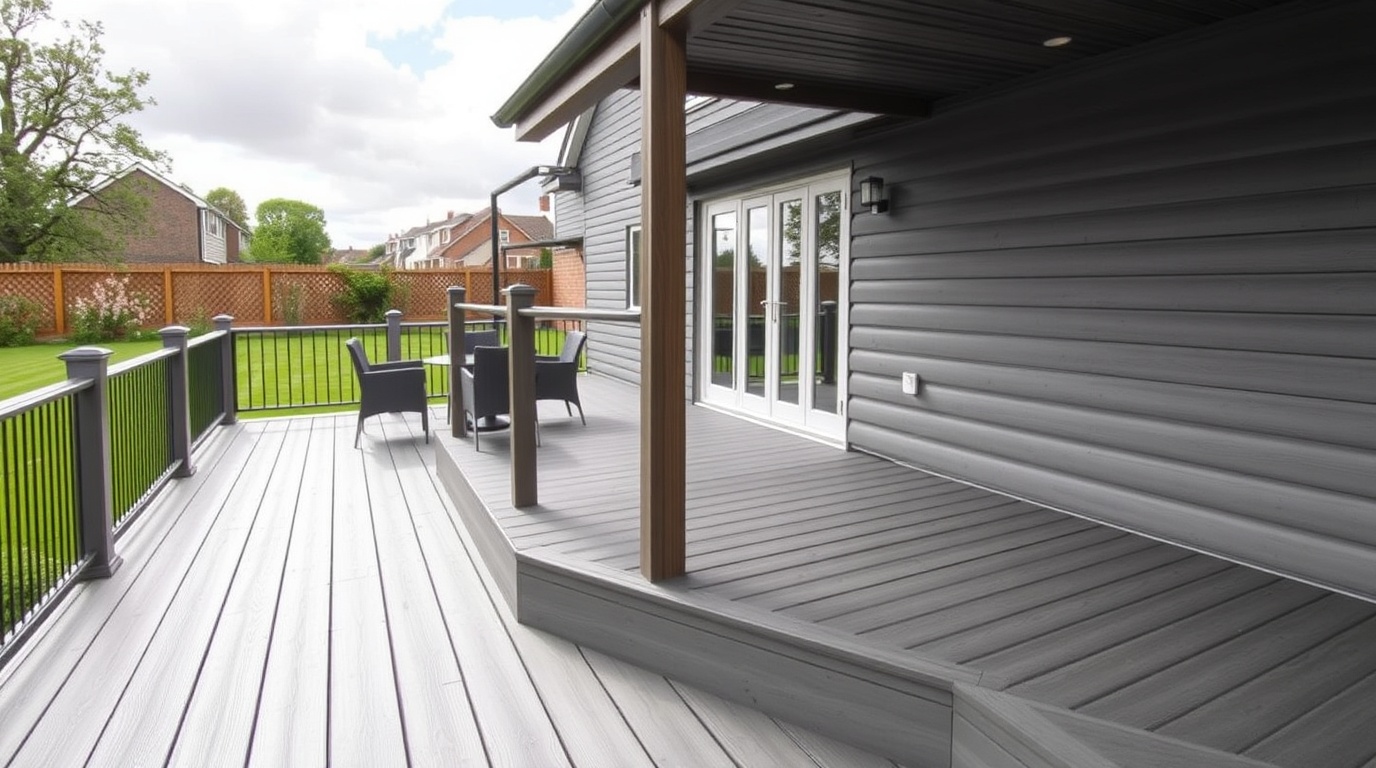
Before cost or looks, the shape of your garden usually points to one option. A paved patio needs a firm, level sub-base of compacted hardcore and mortar, so it works best on ground that is already roughly flat or can be levelled without huge excavation. On a sloping or uneven plot, achieving that level base is expensive and disruptive. Composite decking sits on a timber or aluminium sub-frame supported on adjustable posts or feet, so it can be built out level over a slope, a bank, or uneven ground with far less groundwork. Decking also lets you create a raised platform level with a doorway or to capture a view, which paving cannot do without retaining walls. If your garden steps down from the house, decking is often the cleaner solution.
Composite decking vs paving side by side
The table is a broad guide for a typical UK garden. Treat costs as fitted ranges that vary with materials, ground conditions, access and region.
| Factor | Composite decking | Paved patio |
|---|---|---|
| Indicative fitted cost/m² | £100–£200+ | £75–£200+ |
| Best ground | Slopes, raised, uneven | Flat or levellable |
| Typical lifespan | 20–30 years | Decades, often a lifetime |
| Feel underfoot | Warmer, slight give | Hard, cooler |
| Drainage | Through board gaps | Needs falls + drainage |
| Maintenance | Occasional wash | Wash, occasional weeding of joints |
| Furniture/heavy loads | Good | Excellent |
Indicative fitted ranges for guidance only. Sources: Checkatrade decking and patio cost guides.
Cost and groundwork
On a flat site, a basic patio and a basic deck can cost broadly similar amounts once installed, but the balance shifts with ground conditions. Paving cost is driven heavily by the sub-base: excavation, hardcore, compaction and the mortar bed all add up, and on poor or sloping ground that prep can dominate the bill. Decking cost is driven more by the board quality and the sub-frame; on a slope it often works out cheaper than the equivalent retaining and levelling a patio would need, but premium composite boards on a large area can push the price up. It's also worth remembering that paving is usually a one-off lifetime spend, whereas composite boards, though long-lived, are not permanent. get the work priced up that itemise groundwork separately so you can see where the money goes for your specific garden.
Drainage, slip and weather
Both surfaces have to cope with the UK's frequent rain. Decking drains through the gaps between boards, so water rarely pools on the surface, but the void beneath must be ventilated and free-draining or damp can build up under the frame. Composite stays grippy when textured, though algae can form in shaded, damp spots and needs an occasional wash. Paving sheds water across its surface, so it must be laid to a slight fall away from the house and may need a drainage channel; if the falls are wrong, puddles collect. Smooth or glazed paving can become slippery when wet or frosty, which matters near doors and steps, so a textured or riven finish is safer. In shade, both can grow algae and green up, so neither is maintenance-free — but both clean up easily.
Feel, looks and use
The two create quite different spaces. A patio feels solid and permanent, takes heavy furniture, planters, hot tubs and BBQs without flexing, and reads as part of the building's masonry — a natural extension of the house. It is, however, hard and cool underfoot. Decking feels warmer and has a slight, comfortable give, suits bare feet, and gives a softer, more garden-like character; raised decking can also frame a seating area or step down to a lawn attractively. Composite ranges come in many wood-effect colours, while paving spans natural stone, porcelain and concrete in countless finishes, so both offer plenty of style choice. Think about how you'll use the space: for a heavy hot tub or lots of hard-wearing entertaining, paving is reassuring; for a relaxed, raised seating deck off the back doors, composite often wins on feel.
Maintenance over the years
Both surfaces are fairly low-maintenance, but in different ways. Composite decking needs an occasional wash with soapy water to lift dirt and any surface algae, particularly in shaded spots, and a check that the gaps between boards stay clear so water keeps draining. There's no sanding, oiling or sealing. A paved patio needs washing too, plus periodic attention to the joints — weeds and moss can colonise mortar or sand joints, so occasional weeding, re-pointing or re-sanding keeps it tidy, and a sealant is sometimes applied to porous stone to resist staining. Neither is onerous, but the tasks differ: with decking you're keeping the surface and gaps clean; with paving you're mainly managing the joints and surface staining. Over a decade, both stay presentable with modest effort, which is one reason the choice usually turns on levels, feel and cost rather than upkeep.
Planning and permissions
It's worth knowing the rules before you build either surface. Decking is usually permitted development on a typical house, but a raised platform, decking more than about 300mm above ground, or one covering a large share of the garden can require planning permission, and listed buildings and conservation areas have extra restrictions. Patios at or near ground level are generally permitted development too, but creating a large area of impermeable hard surfacing can have drainage implications, and front gardens in particular have rules encouraging permeable surfaces to reduce run-off. For both, you must keep any new surface at least 150mm below the damp-proof course at the house. None of this is usually a barrier, but checking with your local authority before committing avoids problems later, especially on flats, listed properties or in conservation areas.
Which should you choose
Choose a paved patio if your ground is flat or easily levelled, you want the longest possible lifespan, you'll put heavy items on it, and you like a hard, masonry-style surface. Choose composite decking if your garden slopes or steps down from the house, you want a level platform at door height, you prefer a warmer surface with some give, and you value low maintenance over outright permanence. Many gardens benefit from both — a patio for the hard-wearing dining zone nearest the house and a deck stepping down or out to capture sun or a view. Let the levels of your garden lead the decision, then weigh cost, feel and how you'll use the space.
Frequently asked questions
Is composite decking cheaper than a patio?
On a flat site they are often broadly comparable once fitted, but the answer depends on ground conditions. On a slope, decking is frequently cheaper than the levelling or retaining a patio would need, while on flat, easily prepared ground a simple patio can come out lower. Get itemised quotes that separate groundwork.
Does decking or a patio add more value to a home?
Both can improve a garden's appeal and usability, which supports value, and the better-suited option for your plot tends to add the most. A well-built patio is seen as permanent and low-fuss, while attractive decking can make a sloping or awkward garden usable. Quality of build matters more than the material chosen.
Can you put decking over a patio?
Yes, composite or timber decking can be laid over an existing patio using a low sub-frame or adjustable feet, provided drainage and ventilation are maintained and the build-up does not breach the damp-proof course. It is a common way to upgrade a tired or uneven patio without removing it.
Sources & further reading
Figures on this page are typical UK ranges drawn from published sources and depend on your specific garden. They are guidance, not a quotation.