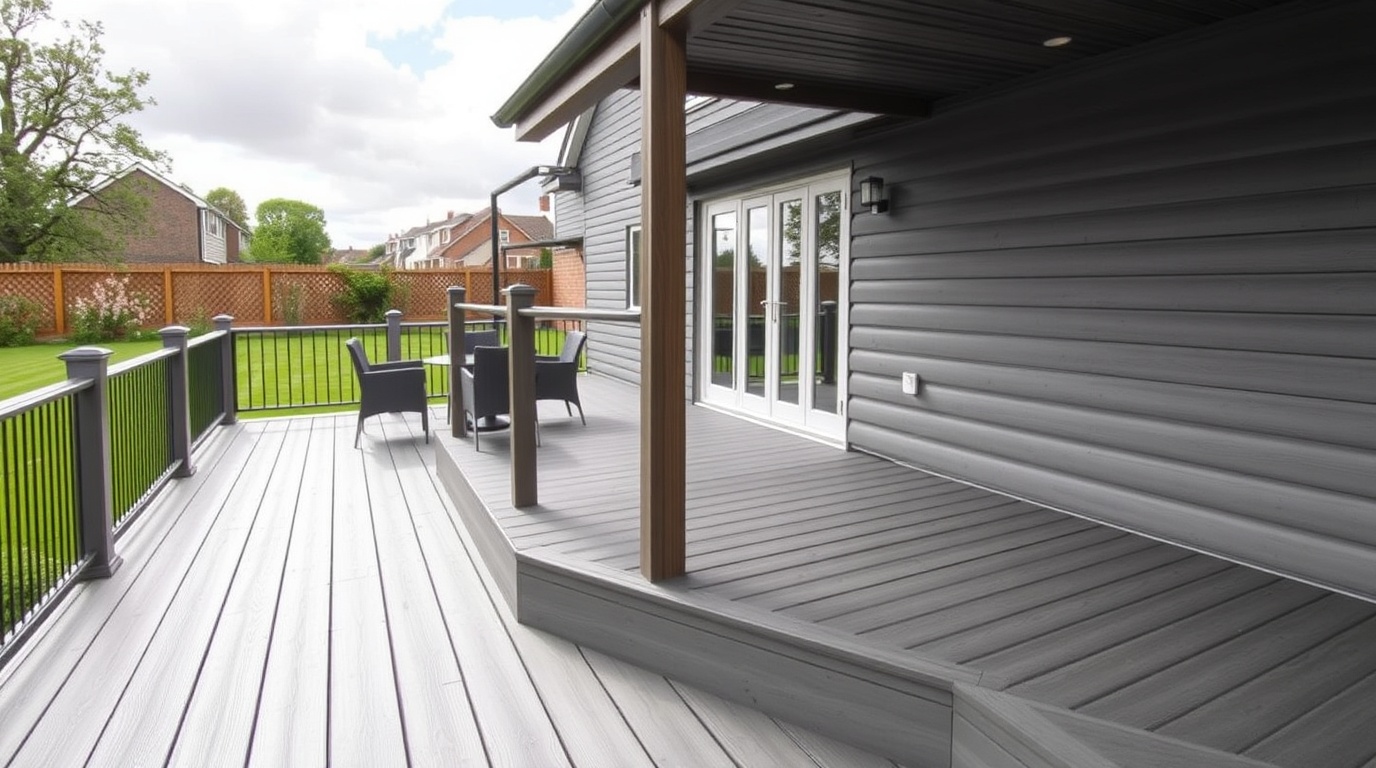
The short answer
Decking on uneven or sloping ground is built by levelling the sub-frame above the ground rather than levelling the ground itself. The frame is supported on posts or adjustable pedestals of varying heights — taller on the low side, shorter on the high side — so the joists end up dead level even though the ground beneath falls away. Posts are usually set into concrete footings for a raised or sloping deck so the structure is firm. A slope has knock-on effects: the deck may rise above 30cm at the low end, which can require planning permission, and water runs downhill, so drainage and rot protection at the low side matter more. Solid, well-anchored posts are the key to a safe sloping deck.
A sloping or bumpy garden is one of the more common reasons people hesitate over decking — but it is a well-understood job. The principle is simple: level the frame in the air, and let varying supports absorb the ground beneath.
Decking on a slope
- Key principleLevel the frame, not the ground
- Support methodPosts / adjustable pedestals
- AnchoringConcrete footings for raised decks
- Planning watch-outLow end may exceed 30cm
- Extra careDrainage and rot at the low side
The principle: level the frame, not the ground
You do not need to flatten a sloping garden to deck it. The established approach is to build a level sub-frame supported on legs of different heights. On the high side of the slope the supports are short; on the low side they are taller. The result is a frame whose top surface is perfectly level, sitting over ground that is not.
This is one of decking's real advantages over patios and paving on a slope: rather than excavating and retaining a slope to create a flat base, you bridge over it with a frame. For minor unevenness, the same idea applies on a smaller scale — adjustable supports or packing take up the bumps so the joists sit true.
Posts, footings and adjustable supports
How the frame is supported depends on how much the ground falls:
- Adjustable pedestals / deck supports: screw-jack style supports that can be wound up or down to fine-tune the level. They suit modest slopes and unevenness, sitting on a firm base.
- Timber or concrete posts: for a meaningfully raised low side, posts are set into concrete footings dug below ground, so the structure is firmly anchored and will not move or settle unevenly.
- Bearers and joists: bearers span between the posts, and joists run across them, all brought to a consistent level so the boards sit flat.
The further a deck is raised on its low side, the more the support structure has to do, and the more important firm footings become. A raised, sloping deck is a structural job — the posts are carrying real load, and concrete footings stop them sinking or leaning over time.
What a slope means for planning and height
A slope has a direct effect on the planning position. Permitted development normally allows decking that is no more than 30cm above the natural ground level. On a slope, the deck can easily be under 30cm at the top of the fall but well over 30cm at the bottom — and if any part exceeds 30cm, the permitted development right is likely lost and you may need planning permission. Measuring at the lowest point of the ground beneath the deck is the safe way to judge it.
Raised, sloping decks also bring overlooking into play: a deck that rises high enough to see into a neighbour's garden is more likely to attract objections and need permission. And the usual exceptions still apply — listed buildings and conservation areas have tighter rules. Because the slope often pushes a deck into 'raised' territory, sloping gardens are one of the most common reasons decking needs an application rather than relying on permitted development.
Drainage, rot and finishing on a slope
Water behaves differently on a slope, and that affects how long the deck lasts. Rain runs downhill beneath the deck and tends to collect at the low side, around the lowest posts and the ground there. Since damp ground is what rots timber and undermines footings, the low side needs the most attention: free-draining ground beneath, posts properly set in concrete with provision to shed water, and good ground clearance so the frame is not sitting in wet.
The visible side also needs thought. The raised low edge of a sloping deck leaves a gap to the ground that is usually closed with skirting or fascia boards, both to finish the appearance and to stop animals nesting underneath — though some ventilation beneath the deck is helpful to keep it dry. On any raised section, a balustrade or handrail becomes a safety necessity rather than a choice. Built with level framing, firm footings, good drainage and proper edge protection, a deck turns an awkward sloping garden into usable level space — which is exactly why decking suits slopes so well.
Stepped and multi-level decks for steeper slopes
On a gentle or moderate slope, a single level platform on supports of varying height is the usual answer. On a steeper slope, raising one whole platform to the level of the high ground would leave a very tall, exposed structure on the low side — which is harder to build, more intrusive, and more likely to need planning permission for height and overlooking. The established alternative is to step the deck down the slope in two or more levels.
A multi-level (split-level) deck follows the fall of the ground in stages, with short flights of steps linking each platform. The benefits are real:
- Each level sits closer to the ground, so the structure is lower and less imposing.
- The deck reads as part of the garden rather than a single tall platform.
- It can create distinct zones — for dining, seating or planting — on different levels.
The trade-off is more framing, more footings and the steps themselves, so a multi-level deck takes longer and costs more to build than a single platform. On steep ground, though, it is often the more practical, better-looking and more planning-friendly solution than one high deck.
Retaining, ground movement and getting advice
A sloping site brings a couple of extra structural considerations beyond the deck frame itself. Where a slope is cut into to create space, or where there is a marked change in ground level alongside the deck, some form of retaining may be needed to hold back soil — and retaining structures are a structural matter in their own right. On weak, made-up or clay ground, posts and footings need to reach firm bearing so the deck does not settle or move unevenly over time, which on a slope is more likely than on the flat because of the added load and leverage on the low-side posts.
For these reasons, a low deck on a gentle slope is often a manageable project, but a steep, high or heavily retained sloping deck moves into territory where professional design and build pay off — both for safety and for a result that stays level and sound for years. If your slope is significant, it is worth getting advice on the footings, any retaining, and the planning position before committing. Done properly, decking remains one of the best ways to reclaim a sloping garden as flat, usable outdoor space; the key is matching the support structure and the level arrangement to how steep and how stable the ground really is.
Frequently asked questions
Can you put decking on a slope?
Yes. Decking suits sloping gardens well, because you level the frame above the ground rather than levelling the ground itself. Supports of different heights — taller on the low side — carry a level frame, with posts set into concrete footings for raised or sloping decks. Watch the 30cm height limit, as the low end can need planning permission.
Do you need to level the ground before decking?
Not fully. Decking is designed to bridge uneven or sloping ground using a frame on supports of varying heights, so you do not need to flatten the garden. The ground is cleared and the supports adjusted to bring the frame level. Major obstructions are removed, but the slope itself is absorbed by the structure.
Does decking on a slope need planning permission?
It often does. Permitted development normally allows decking no more than 30cm above ground, and on a slope the low end frequently exceeds that, which can require planning permission. Measure at the lowest point of the ground beneath the deck, and check with your local planning authority if any part rises above 30cm.
Sources & further reading
- Planning Portal (gov.uk) — decking permitted development
- Checkatrade — decking on a slope and cost guide
- RHS — paths, patios and decking
Figures on this page are typical UK ranges drawn from published sources and depend on your specific garden. They are guidance, not a quotation.